
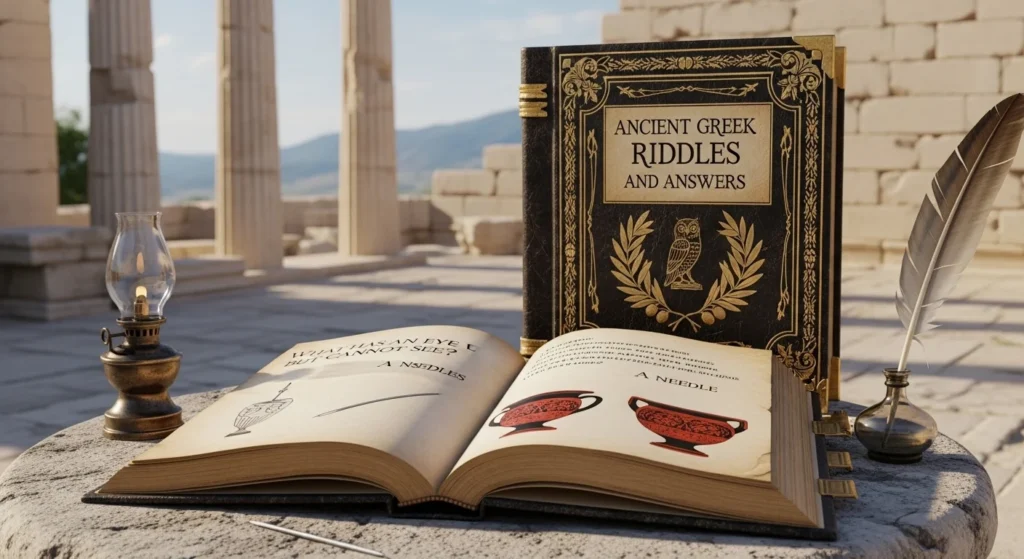
💡 Did You Know?
-
Ancient Greek riddles were often written in hexameter verse, blending poetry with puzzles to sharpen memory and wit.
-
Philosophers like Plato and Aristotle believed that solving riddles enhanced reasoning skills and was an essential part of education.
🎯 Riddle of the Day
I stand in the city yet never move,
I see kings and beggars in my silent groove,
I speak without words, and my stories prove…
Can you guess the answer? Comment below!
🏛️ Ancient Greek Riddles With Answers
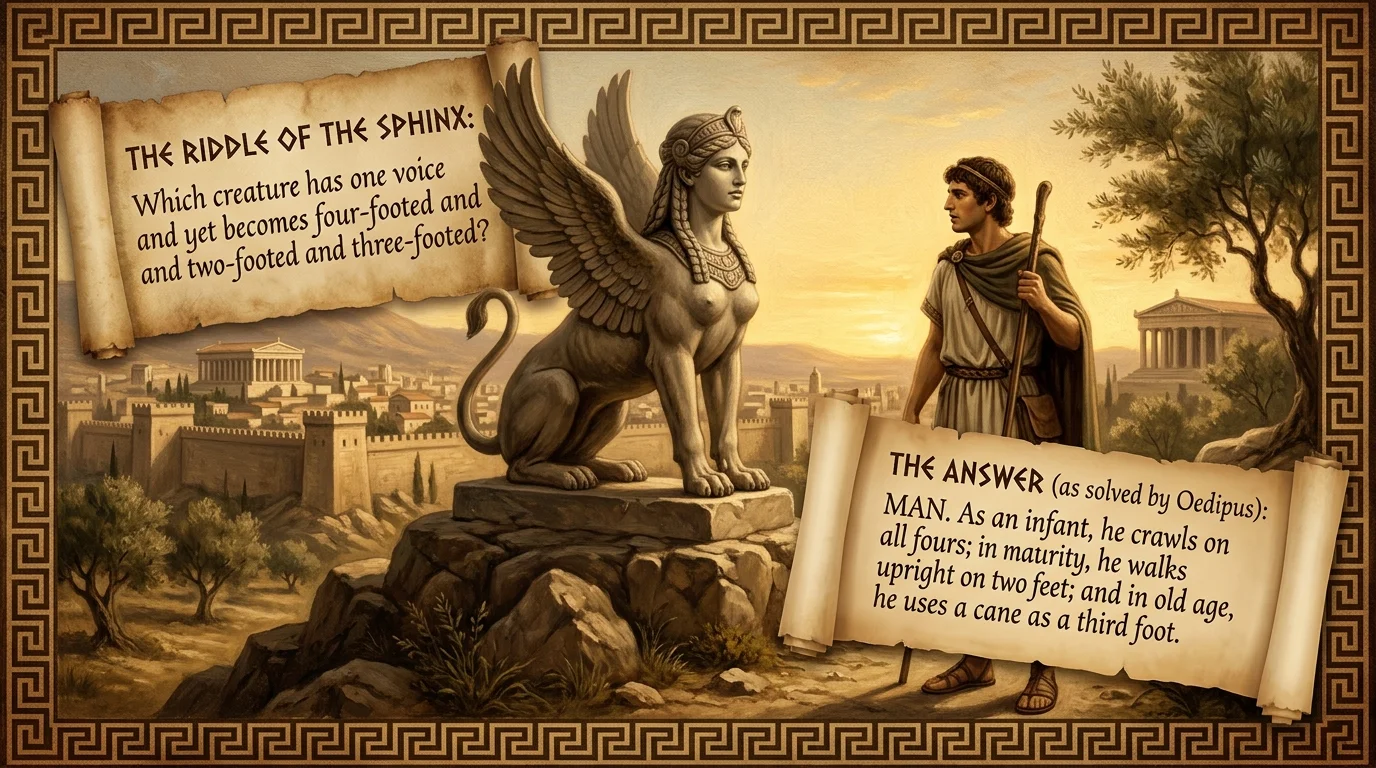
- 👉 I walk on four legs in the morning, two at noon, and three in the evening—what am I? — Human
- 👉 What has roots that nobody sees, is taller than trees? — Mountain
- 👉 I speak without a mouth and hear without ears—what am I? — Echo
- 👉 I can be broken but never held—what am I? — Promise
- 👉 I run forever but never move—what am I? — Time
- 👉 I have cities but no houses—what am I? — Map
- 👉 I am always coming but never arrive—what am I? — Tomorrow
- 👉 I shine but I am not alive—what am I? — Star
- 👉 I am full of holes but still hold water—what am I? — Sponge
- 👉 I can travel the world while staying in a corner—what am I? — Stamp
These riddles reflect the ancient love for wisdom and abstract thinking.
🧒 Ancient Greek Riddles for Kids
- 👉 I shine at night and guide sailors home—what am I? — Star
- 👉 I fly without wings and cry without eyes—what am I? — Cloud
- 👉 I have hands but can’t clap—what am I? — Clock
- 👉 I grow tall but I am not alive—what am I? — Tree
- 👉 I can run but have no legs—what am I? — River
- 👉 I have a face but no eyes or mouth—what am I? — Sun
- 👉 I’m bright during the day and hidden at night—what am I? — Sun
- 👉 I fall but never get hurt—what am I? — Rain
- 👉 I can be seen in the sky after rain—what am I? — Rainbow
- 👉 I light up darkness but I am not alive—what am I? — Fire
Simple, fun, and perfect for young learners exploring mythology-inspired puzzles.
🧠 Ancient Greek Riddles for Adults
- 👉 I measure life but have no shape—what am I? — Time
- 👉 I exist only when you speak of me—what am I? — Reputation
- 👉 I can be kept but never touched—what am I? — Secret
- 👉 I grow stronger when shared wisely—what am I? — Knowledge
- 👉 I am heavy when spoken, light when kept—what am I? — Truth
- 👉 I destroy everything yet cannot be stopped—what am I? — Time
- 👉 I guide kings and fools alike—what am I? — Fate
- 👉 I can be lost in a moment but take years to build—what am I? — Trust
- 👉 I am seen in reflection but not real—what am I? — Illusion
- 👉 I am endless but always moving forward—what am I? — Time
These riddles reflect deeper philosophical thinking found in ancient Greek culture.
🧩 Ancient Riddles With Answers
- 👉 I have no voice but I speak to you—what am I? — Book
- 👉 I can be cracked, made, told, and played—what am I? — Joke
- 👉 I go up but never come down—what am I? — Age
- 👉 I am always in front but cannot be seen—what am I? — Future
- 👉 I have a neck but no head—what am I? — Bottle
- 👉 I can fill a room but take no space—what am I? — Light
- 👉 I run but never walk—what am I? — River
- 👉 I have keys but no locks—what am I? — Piano
- 👉 I am born in silence and die in noise—what am I? — Thought
- 👉 I am broken before you use me—what am I? — Egg
These riddles echo the timeless style of ancient puzzle traditions.
🐍 Greek Riddles from the Sphinx
- 👉 What walks on four legs in the morning, two at noon, and three in the evening? — Human
- 👉 What creature changes its strength but not its form across life? — Human
- 👉 I solve nothing yet confuse all who hear me—what am I? — Riddle
- 👉 I guard the city and challenge travelers—what am I? — Sphinx
- 👉 I am defeated only by intelligence—what am I? — Sphinx’s riddle
- 👉 I speak in mystery and demand truth—what am I? — Riddle of the Sphinx
- 👉 I destroy those who fail to answer me—what am I? — Sphinx challenge
- 👉 I represent wisdom hidden in disguise—what am I? — Sphinx
- 👉 I stand at the gates of Thebes—what am I? — Sphinx
- 👉 I am answered by Oedipus—what am I? — Sphinx riddle
These legendary riddles are among the most famous in mythology.
🧒 Greek Riddles for Kids
- 👉 I rise in the morning and sleep at night—what am I? — Sun
- 👉 I sparkle in the sky at night—what am I? — Star
- 👉 I bring rain and storms—what am I? — Cloud
- 👉 I can be hot and give light—what am I? — Fire
- 👉 I travel without feet across land—what am I? — Wind
- 👉 I fall but never break—what am I? — Snow
- 👉 I shine on your path at night—what am I? — Moon
- 👉 I move in rivers and oceans—what am I? — Water
- 👉 I grow in fields and feed people—what am I? — Wheat
- 👉 I bloom in spring with colors bright—what am I? — Flower
These riddles make ancient-inspired learning fun and easy for children.
🏛️ Greek God of Riddles
- 👉 I am known for wisdom and clever thinking—who am I? — Athena
- 👉 I inspire intelligence and strategy—who am I? — Athena
- 👉 I represent knowledge more than strength—who am I? — Athena
- 👉 I guide heroes with smart decisions—who am I? — Athena
- 👉 I was born from the head of Zeus—who am I? — Athena
- 👉 I symbolize logic and reason—who am I? — Athena
- 👉 I protect cities with wisdom, not force—who am I? — Athena
- 👉 I am linked to puzzles and intellect—who am I? — Athena
- 👉 I am worshipped in Athens—who am I? — Athena
- 👉 I embody clever problem-solving—who am I? — Athena
Athena represents wisdom, making her closely tied to riddles and intelligence in Greek mythology.
🧠 Mythological Riddles
- 👉 I rise from ashes again and again—what am I? — Phoenix
- 👉 I guard treasures with many heads—what am I? — Hydra
- 👉 I trap travelers in endless song—what am I? — Siren
- 👉 I half-man, half-bull, lost in a maze—what am I? — Minotaur
- 👉 I carry the sky on my shoulders—what am I? — Atlas
- 👉 I steal fire for mankind—what am I? — Prometheus
- 👉 I am punished to push a rock forever—what am I? — Sisyphus
- 👉 I open the box that releases chaos—what am I? — Pandora
- 👉 I guide souls to the underworld—what am I? — Charon
- 👉 I am the ruler of the sea—what am I? — Poseidon
Mythological riddles connect storytelling with deep symbolic meaning.
🎯 Riddle of the Day
- 👉 I ask a question no one can escape, and only wisdom can reshape—what am I?
🏛️ Classic Ancient Greek Riddles
-
I fly without wings and see without eyes 👉 Time
-
I follow you always yet you cannot touch me 👉 Shadow
-
I speak in riddles yet never tell lies 👉 Oracle
-
I run without legs and dance over hills 👉 River
-
I have cities but no houses, forests but no trees 👉 Map
-
I bring light without fire and shine at night 👉 Moon
-
I am born from wisdom and guard the wise 👉 Knowledge
-
I feed many yet eat nothing myself 👉 Sun
-
I am a bridge between gods and men 👉 Prayer
-
I can be heard but never held 👉 Echo
🏺 Mythology-Inspired Riddles
-
I wear wings on my feet and carry messages 👉 Hermes
-
I have snakes for hair and turn men to stone 👉 Medusa
-
I flew too close to the sun and fell 👉 Icarus
-
I am half-man, half-goat, and dance in the woods 👉 Satyr
-
I hold the sky on my shoulders 👉 Atlas
-
I change shapes and haunt heroes 👉 Proteus
-
I am the golden fleece everyone seeks 👉 Chrysomallos
-
I guard treasures and breathe fire 👉 Dragon
-
I am blind but hear all in the underworld 👉 Tiresias
-
I travel the seas and conquer monsters 👉 Odysseus
🏛️ Philosophical and Logic Riddles
-
I question everything yet hold no answers 👉 Philosopher
-
I am a circle of thought with no end 👉 Reason
-
I am both many and one 👉 Soul
-
I grow with learning yet shrink with ignorance 👉 Mind
-
I hold truth yet wear a mask 👉 Rhetoric
-
I can be broken but not held 👉 Promise
-
I am invisible yet shape the world 👉 Idea
-
I am sought by kings and beggars alike 👉 Justice
-
I shine brightest in darkness 👉 Knowledge
-
I speak only when listened to 👉 Silence
🌊 Sea and Nature Riddles
-
I crash yet I do not shout 👉 Wave
-
I am home to Poseidon and sing to sailors 👉 Ocean
-
I hide treasures in my depths 👉 Sea
-
I reflect the sky yet never fly 👉 Water
-
I sleep in winter and wake in spring 👉 Tree
-
I am a circle of fire in the sky 👉 Sun
-
I vanish when touched yet linger in air 👉 Mist
-
I roar yet have no mouth 👉 Wind
-
I carry ships and swallow them too 👉 Sea
-
I am soft as feathers but can break mountains 👉 Sand
⚔️ Heroic and Adventure Riddles
-
I wear armor yet never fight 👉 Statue
-
I sail without a ship and travel without legs 👉 Story
-
I am a hero without a face 👉 Legend
-
I fight monsters without hands 👉 Mind
-
I seek glory but never boast 👉 Courage
-
I climb mountains yet stand still 👉 Flag
-
I ride horses yet never leave home 👉 Chessboard
-
I cross rivers without getting wet 👉 Bridge
-
I face beasts without fear 👉 Imagination
-
I conquer lands yet own none 👉 Name
🏺 Daily Life and Ancient Greek Society Riddles
-
I am full of words yet never speak 👉 Book
-
I sit in the agora and see all 👉 Statue
-
I carry water yet have no mouth 👉 Well
-
I guard the city yet sleep at night 👉 Gate
-
I shine in gold but cannot be held 👉 Coin
-
I am worn by kings yet touch all 👉 Crown
-
I travel without moving 👉 Shadow
-
I hold stories but have no eyes 👉 Scroll
-
I am given in feasts yet take nothing 👉 Cup
-
I shine in temples yet hold no flame 👉 Sunlight
🎭 Art, Theater, and Drama Riddles
-
I cry yet have no eyes 👉 Tragedy mask
-
I speak lines yet have no tongue 👉 Script
-
I move crowds yet stand still 👉 Actor
-
I hold a stage without legs 👉 Theater
-
I tell stories in silence 👉 Painting
-
I fly without wings on stage 👉 Imagination
-
I wear costumes yet never sleep 👉 Puppet
-
I vanish when the curtain falls 👉 Scene
-
I hold the audience captive yet free 👉 Play